
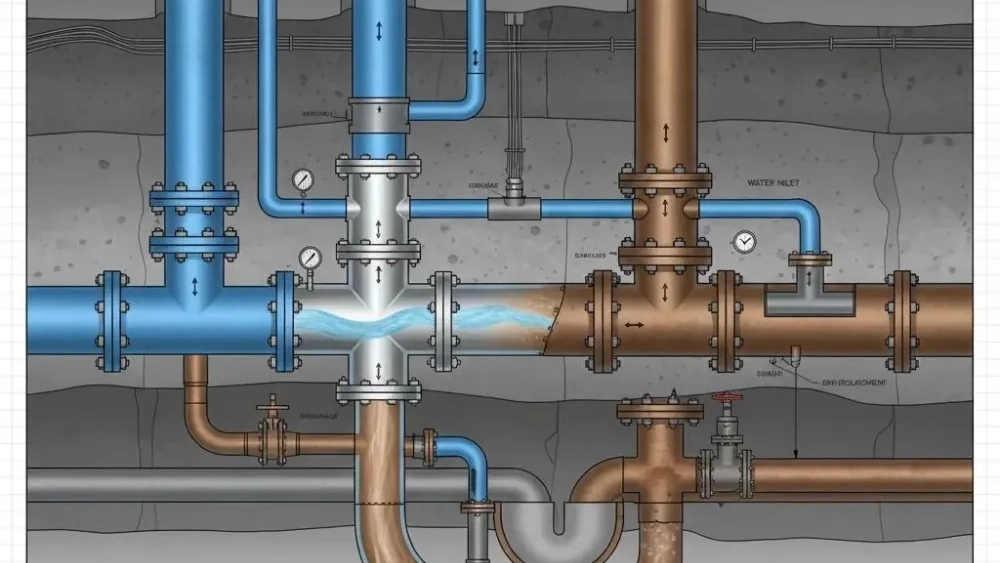
1. Definition and function
2. Main components
- Body: the main part that sits on the pipe and bears the pressure.
- Sealing rubber (gasket): to prevent leakage at the point of contact between the manifold and the pipe.
- Bolts and fasteners: to secure and stabilize the part on the pipe.
- Drilling valve or valve: to control the flow at the branching point.
3. Applications
- Creation of household branching of city water without interrupting the flow.
- Connecting new lines to the main network.
- Connection of measurement or temporary pumping systems.
- Exploiting in conditions where it is not possible to break the main path.
4. Types of splitters
| Type | Gender | Application | Working pressure (bar).
| Ductile iron Resistant and heavy Main urban lines 10-16 |
| Polyethylene Light and stainless Areas with wet soil 6-10 |
| Stainless steel Industrial High pressure and chemical lines 16+
5. benefits
✅ Reducing the need for drilling and line cutting
✅ The possibility of installation in operating lines
✅ High speed and economic savings
✅ increasing safety and reducing the risk of leakage
6. Installation and maintenance tips
- The pipe surface must be completely clean.
- Tighten the screws symmetrically.
- System pressure should be controlled before drilling.
- After installation, leak test should be done.
- Check the gaskets at regular intervals.
7. Technical standards and considerations
The use of ISO 4427, EN 12201 and ISIRI 14427 national standards for materials and connections is mandatory.
summary
The manifold plays a central role in the development of infrastructure networks, and the use of high-quality and standard models helps to reduce costs, increase the durability of the system, and prevent water wastage.