
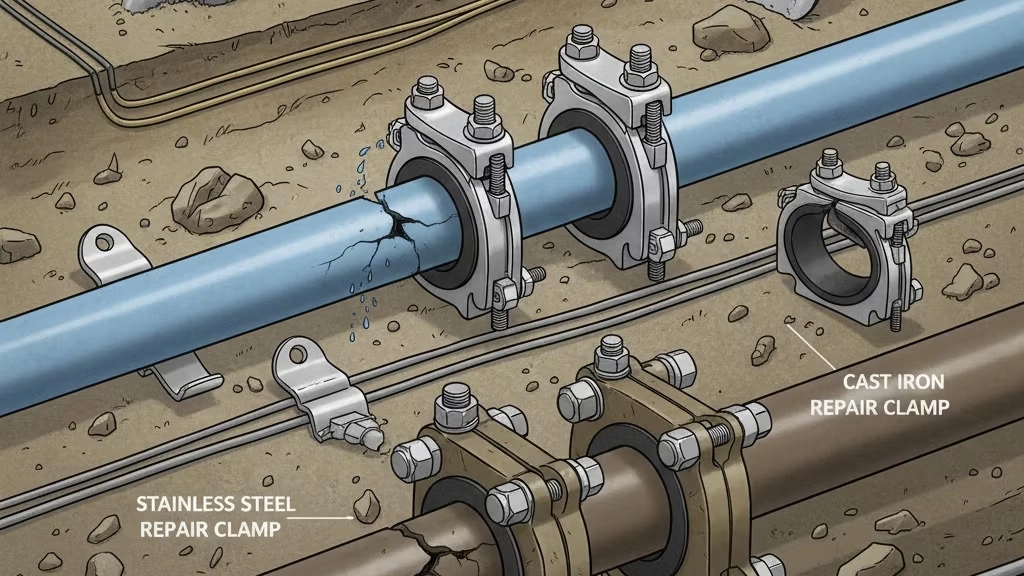
Repair clamp or pipe repair clamp is one of the most essential equipments in the maintenance and repair of fluid transmission networks. This seemingly simple tool plays a vital role in reducing system downtime, preventing water, gas or sewage leaks and facilitating on-site operations. In the water supply, sewage, petrochemical, agricultural and even urban facilities industries, the use of repair clamps makes it possible to quickly repair the damaged part without the need to completely cut the line. In the following, we will fully review the features, types, uses, installation method and tips for choosing the correct pipe repair clamp.
What is a repair clamp?
The repair clamp consists of two or more main parts, which usually have a steel or stainless steel body and a rubber gasket. This clip is designed in the form of two semi-circles, so that it can be fixed by bolts and nuts after being placed around the crack or broken pipe.
In fact, the function of this piece is similar to a retaining belt that is installed on the damaged part and provides the necessary pressure to seal the leak. Depending on the size of the pipe and the type of fluid, the thickness of the body, the type of seal and the dimensions of the screws are different.
Technical structure and components of the repair clamp
A standard repair clamp usually includes the following components:
- Metal or stainless steel body: The main part of the clamp that surrounds the pipe.
- Gasket: It is used to create complete insulation in the leak area and is usually made of NBR or EPDM.
- Galvanized or steel bolts and nuts: To close the clamp on the pipe and create pressure. Uniform.
- Assembly and locking edges: To prevent the clip from slipping during installation.
In industrial and urban projects where pipelines are under high pressure, stainless steel (grade 304 or 316) is the most used because it has high resistance to corrosion.
Types of pipe repair clamps in terms of application
1. Single Band Repair Clamp
This type is suitable for small cracks and surface holes in pipes up to medium diameter. It has a fast installation and is used in most water supply lines.
2. Double Band Clamp
It has two parts connected together, which increases the contact surface and makes it stronger. An excellent option for high pressure and large diameter pipes.
3. Multi Section Clamp
To repair long cracks or damage, it is made of two or more connected parts. It is used in industrial sewage networks and main transmission lines.
4. Tapping Clamp
This type of clamp is used when we want to take a new branch from the existing pipeline. In the upper part of the output clamp, there is a rib or flange.
Common applications of repair clamps
- Urban water networks: Immediate prevention of water leakage in steel, cast iron or polyethylene pipes.
- Industrial facilities and factories: Repair of chemical fluid transfer lines without stopping the production line.
- Gas and oil networks: Quick sealing of metal or composite lines.
- Agricultural fields and irrigation: Pressure maintenance in pipe systems Polyethylene and PVC.
- Sewage network: prevent leakage and penetration in concrete pipes or reinforced polymers.
Using a repair clamp saves money and time because it eliminates the need to cut, weld, or completely replace the pipe.
Advantages of using repair clamps
- Easy and quick installation: No need for heavy equipment.
- Can be used in all types of pipes (polyethylene, steel, cast iron, UPVC, etc.)
- High resistance to pressure and temperature.
- Possibility to carry out repairs during the operation of the line.
- Capable of complete sealing even in longitudinal cracks or Circular.
- Economical price compared to traditional methods such as welding or changing the section.
- Long life due to the use of anti-corrosion material.
How to install the repair clip on the pipe
The installation process is slightly different depending on the type of pipe and type of clamp, but the standard steps include the following:
- Cutting off or reducing the pressure of the pipeline.
- Cleaning the damaged area from rust, sediment and pollution.
- Putting a rubber semi-circle (washer) on the leakage area.
- Closing the metal part of the clamp around the pipe and adjusting the screws uniformly.
- Gradually increasing the screw torque until sealing is achieved. Complete.
- Pressure test after installation.
If the system is in operational mode (Online Repair), the fluid pressure should not exceed the limit defined by the clamp manufacturer.
Tips for choosing the right repair clamp
- Calculate the exact diameter of the pipe and the location of the damage with a caliper or ruler.
- Specify the type of fluid (water, gas, acid, sewage).
- Know the working pressure of the line (in Bar).
- In corrosive environments, use a clamp made of 316 steel. Clamps with a softer inner cover should be used so as not to damage the body.
The difference between repair clamps and mechanical connections
Repair clamps are used for temporary or permanent repair and sealing, while mechanical couplings are mostly used for connecting two new pipe pieces or replacing a cut section. There is also a more accurate compression system in mechanical joints, but their installation requires a complete cutoff of the current.
The use of repair clamps in urban water and sewage networks
In urban networks, old steel lines are often used, which corrode, crack or leak over time. In such a situation, cutting off the water to completely replace the pipe is not economically and operationally cost-effective. Operating engineers can seal the damaged section in less than 30 minutes using the repair clamp. This method not only prevents water loss but also does not require extensive digging and long stoppages.
The most used examples of repair clamps in the Iranian market
Many Iranian brands such as "Pars Fitting", "Paya Sanat", and "Ab Fam Sharq" produce these equipments with international standards.
International standards related to repair clamps
Complying with these standards guarantees that the clamp can withstand the pressure, temperature and vibrations of the system.
Safety tips during installation
- Before loosening the screws, make sure there is no excess pressure in the line.
- Never install the clamp on a rusty or uneven surface.
- Use a specified torque wrench to tighten the screws.
- On gas lines, installation must be done by authorized personnel with a safety license.
summary
The pipe repair clamp is a simple but vital tool in the maintenance of fluid transmission networks. By using this product, all types of leaks and fractures can be repaired in the shortest time without interrupting the flow. High durability, easy installation, low cost and usability in different conditions are the reasons for its popularity in different industries. Choosing the right type and material of the clamp, based on the pressure and material of the pipe, will guarantee a successful and safe repair.